David Lynch Remembered by Xiu Xiu a Year After Death with Stage Show
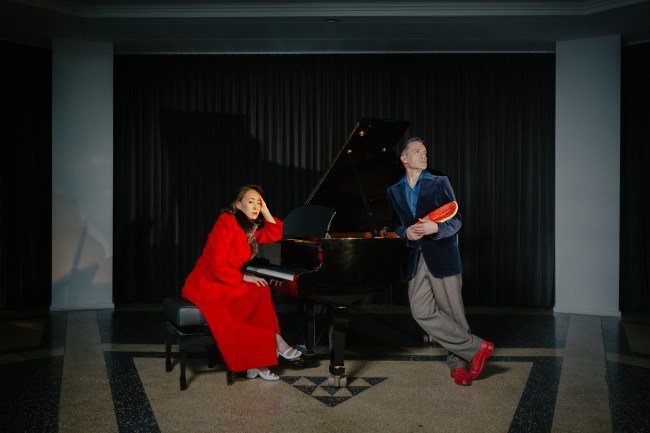
The Los Angeles-based experimental pop band Xiu Xiu are the most famous interpreters of David Lynch’s soundtracks and soundscapes. So, to meet founding member Jamie Stewart in the backroom of Stockholm’s music venue Slakthusen, or slaughterhouse, on a twilit winter afternoon feels appropriate. A loud, ambient hum throughout our interview renders it almost spiritual.
The band is midway through a European tour of their new show., Eraserhead Xiu Xiu, a reinterpretation of Lynch’s 1977 debut feature that follows on from their wildly successful show Xiu Xiu Plays the Music of Twin Peaks. Stewart, who uses they/them pronouns, is according to several mutual friends “a sweetheart,” a description that instantly cracks them up and loosens any wintry insularity.


Originally commissioned as a one-off performance by Brisbane’s Gallery of Modern Art to coincide with an exhibition of David Lynch’s artwork, Xiu Xiu Plays the Music of Twin Peaks ended up touring for three years after the series made a surprise return with a third season, birthing a new generation of fans. When Lynch died, Stewart said, audiences and presenters asked whether the band would revive the show. Xiu Xiu, who have released around 20 albums since starting in 2002, declined.
“We wouldn’t exist without David Lynch,” Stewart said. “But it felt disingenuous to play it again at this point. I mean, it was very much of that moment, and it is too important to us to just go through the motions.”
“The word fandom sometimes seems a little bit diminishing,” they continued, “but I think because — and this is gonna make me sound very cheesy, but I’m sure you feel the same way — art is deeply impactful and important to my existence, and I am regularly profoundly moved by it. Getting to explore that is not something we take lightly. This kind of participatory fandom is something we put everything we have into.”
Instead, Stewart and musical partner Angela Seo began developing a new performance based on “Eraserhead.” The choice was pragmatic as much as reverential. “‘Twin Peaks’ and ‘Eraserhead’ are the only Lynch works with that kind of singular sonic environment,” Stewart said. “All the music and all the movies are excellent, but you couldn’t really do a ‘Mulholland Drive’ concert. The music goes in a lot of different directions.”

“Eraserhead” only features one original song, “In Heaven,” and two songs by jazz pianist Fats Waller, but its sound design, created by Lynch and Alan Splet, is a universe unto itself. Its combination of homemade industrial drones, mechanical pulses, and sustained low frequencies functions almost as a continuous score. While Sacred Bones Records has released an official soundtrack sourced directly from the film’s audio, Stewart said that exact reproduction was never the goal.
“Because Alan Splet and David Lynch did something so specific, it was not that difficult to take that palette and expand from it,” Stewart said. “It’s not a remix of ‘Eraserhead’, but we took their very definite and particular ideas and grew ideas out of that.”
The development process began with repeated viewings of the film, an extensive rereading of Lynch’s published interviews and biographies. Stewart assembled a palette of sounds, but early on, the project stalled.
“I had all the sounds,” Stewart said. “And then I was stuck.”
Seo proposed a structural solution. Instead of approaching the film musically, the pair mapped it narratively. Watching the film again, they divided it into 30 to 40 discrete segments. “The baby appears,” Stewart said. “Dinner at Mary’s, Henry alone at home; each one got a heading.”
Each segment was assigned a general duration and a cluster of sounds. From there, Stewart and Seo rehearsed through improvisation. According to the band’s press release, the show uses “field recordings, homemade instruments, organ, modular synths, vocals, flashlights, electrical interference, and elements of musique concrete”.
“Eraserhead” has been interpreted as a film about parenthood, industrial alienation, masculinity, and anxiety. Stewart does not dispute those readings, but they were not the focus of the performance.
“I’m not a parent,” Stewart said. “That aspect wouldn’t have been honest for me.”
Instead, Stewart and Seo concentrated on what Stewart describes as the film’s “dark sexuality.” They emphasized that this was not intended as a revisionist interpretation or a claim of discovery, but something that became obvious on repeat viewings.

“Dark sexuality is something that is part of my normal life,” Stewart said. “I have some — and Angela has some — familiarity with that, so it seemed interesting to have that be a bigger part of the aesthetic. With ‘Twin Peaks,’ we needed to narrow our focus, so we said, ‘What if BOB was playing the music of “Twin Peaks”?’ There is a lot going on in “Eraserhead,” but mostly we’re focusing on the dark sexuality and violence — I mean, there’s infanticide in it — and not so much the familial themes or the failure of industrialism.”
When asked about the appeal of these aspects, Stewart said, “A lot of it just comes from personal history, you know? Unfortunate aspects of my personal history. This is an annoying thing to say, but I try not to be too analytical about it. If I think too hard about something, it tends to unravel or start feeling a little bit less genuine than I wanted to. So, I found that those are the things I was reacting to and thought, ‘OK, let’s just go with it.’”
That distinction matters within Xiu Xiu’s broader body of work, which is frequently described as confessional. Stewart agrees that many Xiu Xiu albums function as personal documents and diaries. Projects like Eraserhead Xiu Xiu, though, occupy a different category.
Stewart first encountered this mode of working during the “Twin Peaks” project. “It was the first time, as an adult, that I’d made music that wasn’t directly about my own experiences,” Stewart said. Rather than inserting Xiu Xiu’s narrative into the material, the band’s goal was to approach the work from within its existing aesthetic logic. “We weren’t trying to turn ‘Twin Peaks’ into Xiu Xiu,” they said. “We were trying to honour it by working inside something it helped create.”
The same approach applies to “Eraserhead.” Stewart resisted analysis of their own motivations. “I try to stay in what I think of as the lower brainstem,” they said. “If you intellectualize too much, it can unravel.”
That philosophy aligns with Lynch’s own refusal to explain his work. “That’s the gift,” Stewart said. “Not telling people what to think.”

Xiu Xiu’s relationship to Lynch himself has been longstanding, but indirect. The band performed at Lynch’s Festival of Disruption in 2016, but Stewart elected not to meet with him. “I was too scared,” they said. Stewart later learned that Lynch had been standing side-stage during the band’s festival performance. “I’m so glad I didn’t know,” they said, laughing with relief. “It was obviously incredible that he watched us play, but I would not have been able to handle it.”
Stewart believes it’s for the best that there were never discussions about collaborating with Lynch. “We don’t sound like the music he puts in his films,” they said. “But I think we sound like what his films feel like.”
This distinction also explains why Xiu Xiu did not appear at the Roadhouse during “Twin Peaks: The Return.” “All of those bands sound like music that would be in his movies or that he likes,” they said. “Although he was very, very supportive of what we did, he doesn’t really need that. Personally, it would have been cool, but I didn’t feel bad about it because it didn’t really add up. When I saw who else was doing it, I was like, ‘OK, that all completely makes sense.’”
When the news of Lynch’s death broke, Stewart said they were surprised by the intensity of their reaction. “I intellectually understand parasocial relationships, but I feel like somebody who was a big part of my life died,” they said. “It still felt like losing someone important. Right when it happened, I wanted to connect with somebody who would understand, so I called a friend of mine who is another massive David Lynch fan. He’s also into Transcendental Meditation, and he said something really nice. He said, ‘You know, he was probably totally blissed out in a meditative state, like, right before he went.’ Considering his devotion to that practice, it seems likely that he would have been.”
That emotional response partly informed the decision to create Eraserhead Xiu Xiu, though Stewart is careful not to frame the performance as a memorial.
“Usually working on music is not particularly cathartic, and performing this concert is stressful because it’s new and we’re still concentrating on the technical aspects, but as we’re putting it together, there was definitely a sense of catharsis,” they said. “It’s a way to sort of say thank you and goodbye.”
Eraserhead Xiu Xiu continues its tour through April with shows in Miami, Liverpool, Glasgow, Athens, and more.