Can AI Solve Hollywood’s Biggest Problems: Sundance Panel
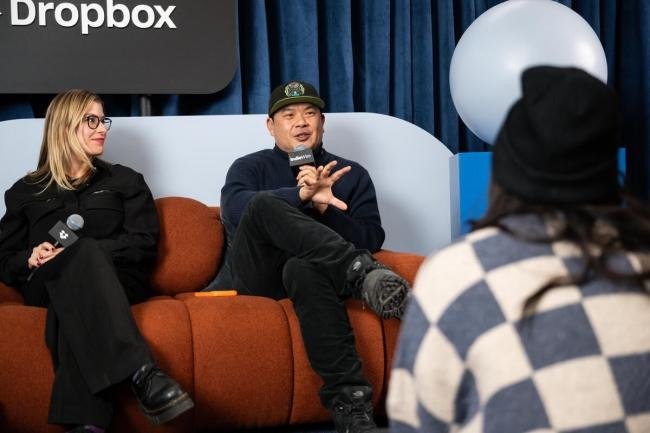
Many believe the real future of AI in Hollywood is not a radical shift in how we make movies and television, but rather solving problems and creating opportunities that are currently unavailable to filmmakers and studios. This was a big part of the conversation during the “AI and Filmmaking: Clearing Space for Creativity” panel discussion at the IndieWire Studio, presented by Dropbox, with Othelia co-CEO and co-founder Alexandra Hooven, Primordial Soup producer Jess Engel, and Pickford.ai head of creative Bernie Su.
Su’s new project, “Whispers,” an AI-driven interactive thriller in which viewers participate in the story by helping strategize in real time to solve the crime and catch the killer, demonstrates how AI is opening the door to new forms of storytelling that otherwise wouldn’t be possible. As Su discussed while on the panel, the ramifications of this for Hollywood is less about how it makes its big movies, but rather solving a problem the industry currently has with its most valuable assets. He points to the breakout success of “K-Pop Demon Hunters,” which he describes as a piece of “generational IP” that Netflix won’t be able tap into again until the recently announced sequel is released in 2029.


“It’s this is a problem, you’re sitting on a little gold mine and you can’t open it again until 2029, isn’t that insane?” said Su, who believes AI-driving interactive projects like his point to ways, “ where you can let fans engage or play in their little sandbox.”
Su is clear, to protect and grow the franchise, the same care and time needs to put into making a sequel, like “K-Pop,” including writing new bangers songs and an engaging story, but during that four year layoff, AI could allow passionate audiences to engage with their fandom that both protects the IP, but also opens doors to new possibilities.
“It’s a problem that old media has, that ironically new media is really good at,” said Su. “Like games are really good at this: ‘You want more characters, we’ll make them for you and you can play them in ‘League of Legends,’ no problem.’ ‘You need a character in ‘Fortnite,’ we’ll get them there next week.’ But for us to get another piece of content officially from ‘K-Pop Demon Hunters’ it’s going to be maybe four years before they roll something out.”
Hooven, whose company’s software helps storytellers build, edit, and expand complex worlds using non-generative AI, agreed with Su, speculating that this is what was behind Disney’s recent deal with OpenAI.
“It’s not because Disney thinks the next Disney movies aren’t going to be created by individuals,” said Hooven, who believed the deal was about protecting the company’s value franchises. “We’re not going to uninvent these tools, right? We need to figure out how to utilize them. What Bernie’s doing is opening up new ways to interact with these characters. Making sure, by getting ahead of it (Disney can make sure) there are constraints and rules associated with whatever manipulation and creation is going along with these characters.”
Engel, who is working with Darren Aronofsky and filmmakers to explore what opportunities and tools there are to build worlds that otherwise wouldn’t be impossible working on a smaller, independent scale, will open doors for independent filmmakers. Which is why she believes Sundance, and the community that gathers at the festival, should be more engaged on the topic of AI, and find ways to incorporate it into the New Frontiers programming.
“Filmmaking is where storytelling and technology intersect. And as technology is becoming more and more a part of our lives and the way (storytelling) is shared,” said Engel. “It just makes sense to have some form of that here at Sundance because it’s about building that community around it and the conversations around it.”
Watch the complete “AI and Filmmaking” conversation above.
Dropbox is proud to partner with IndieWire and the Sundance Film Festival. In 2026, 68% of feature films premiering at Sundance used Dropbox during production. Dropbox helps filmmakers and creative teams find, organize, secure, and share the content that matters most to any project.