See You When I See You Review: Jay Duplass’ Uneven Tragicomedy
Stop me if you’ve heard this one before: A lost but undeniably likable young man finds himself in the wake of a terrible tragedy that upends his life. He’s sad, but in a relatable, sympathetic sort of way, which allows the audience to cheer him on through the inevitable mistakes made and lessons learned. This brand of coming-of-age film is evergreen in the indie film world, and is oftentimes so overflowing with stylistic and narrative clichés that the movies can feel like a genre unto themselves.
“See You When I See,” directed by Jay Duplass and starring Cooper Raiff (“Cha Cha Real Smooth”), fits squarely into this Sundance-friendly mini-genre. The screenwriter, Adam Cayton-Holland, based the story on his memoir about his younger sister’s suicide, and he adapts the true-life material as a kind of family-dysfunction tragicomedy. Take an early scene by a taco truck: Aaron (Raiff), a jokester with a depressive streak who deflects from serious topics with humor, calls to schedule a session with the therapist his type-A older sister, Emily (Lucy Boynton) found for him. But just as he starts to leave a voicemail, a bird poops on his head.


Such is the style of big-studio soft-sell comedy one can expect from this movie, which also occasionally erupts into whimsical memory-cum-fantasy sequences that center on Aaron’s little sister, Leah (Kaitlyn Dever), who died several months before the film opens. These dreamlike flashback scenes — which, in a Michel Gondry-inspired twist, feature a mixture of Aaron’s memories and lucid new exchanges — give Aaron the chance to convene with Leah, asking the questions and demanding the answers he never got during her life. The sequences end with Leah being sucked upward into a quaking fissure in the sky: a motif for loss that would have felt more inventive if we didn’t already live in a post-“If I Had Legs I’d Kick You” world.
But despite its preciousness (and a wildly saccharine score), “See You When I See You” nevertheless leaves you with a good taste in your mouth. It’s so earnest, so vulnerable in its portrait of the disappointments and anxieties of young adulthood, that one tends to forgive its tweer flights of fancy.
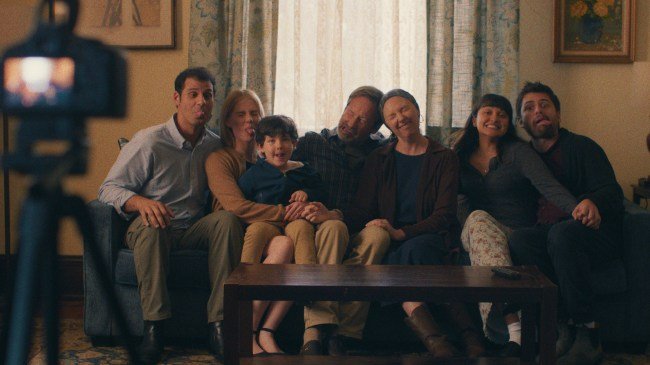
The movie opens with Aaron, Emily, and their parents, Paige (Hope Davis) and Robert (David Duchovny), clearing out Leah’s apartment. They argue over which miscellanea to keep, and whether they should organize a funeral. Robert and Emily, both lawyers at a family firm in town, are pushing for the ceremony; Paige and Aaron, the less practically-minded of the family, are staunchly against one.
The movie goes onto trace each of the family members on their journeys through grief. Aaron works at a comedy-writing website he founded and drinks too much. Paige contends with her own health crisis that she refuses to get checked out. And Robert, though prone to open and perhaps unprofessional discussion of Leah’s suicide with clients, is biased against therapy based on a previous negative experience.
Amid this slew of senselessly avoidant, irrational behavior, Duchovny’s performance emerges as the most credible. Raiff plays a version of the guy he’s always tasked with performing: a puppy-dog-eyed sad clown nevertheless intended to earn the audience’s unqualified sympathy. The other characters regularly lapse into exposition syndrome, as in a scene that tracks Paige Googling the term “PTSD.” They are a privileged and fortunate bunch acting irresponsibly after a family tragedy — a fact that the film acknowledges, at least obliquely, when a side character shrewdly tells Aaron, “You got a DUI. This isn’t like private school detention.”
As in many stories about suicide, the drama ultimately hangs on an air of misplaced self-blame — a reflex so familiar in cinema you half expect Robin Williams’ “It’s not your fault” speech from “Good Will Hunting” to echo in the background. Seeking distraction and support, Aaron tries to reconnect with Camila (Ariela Barer), the situationship he ghosted when Leah died. Camila is a welcome presence, pushing back on his narcissistic antics even as she still ultimately serves as a vessel for his distress.
The movie’s strongest sequences arrive in the second half, once Aaron begins to shed his most selfish impulses and gets up the nerve to pursue therapy. At this point, many movies would simply portray him walking into the therapist’s office and move on, considering it a lesson learned and battle won. But “See You” wisely lingers in the treatment sessions, dedicating full sequences to the involved process by which the doctor, who specializes in EMDR therapy, helps Aaron attend to his trauma. The technique involves a buzzer that vibrates rhythmically on each of Aaron’s thumbs while he returns, in memory, to the traumatic event: the moment he discovered Leah’s body.
These therapy scenes are a beautiful way to round out a film about a challenging topic, offering fresh insight to a story we’ve seen before. And for those of us who have long grown tired of watching flawed and avoidant young white men make the circuitous journey toward seeking help, the scenes also build sympathy for Aaron. He is coping with an unthinkable loss, and though he is not yet equipped to tackle it, the film surrounding him ultimately proves that it is.
Grade: B-
“See You When I See You” premiered at the 2026 Sundance Film Festival. It is currently seeking U.S. distribution.
Want to stay up to date on IndieWire’s film reviews and critical thoughts? Subscribe here to our newly launched newsletter, In Review by David Ehrlich, in which our Chief Film Critic and Head Reviews Editor rounds up the best new reviews and streaming picks along with some exclusive musings — all only available to subscribers.