‘Stranger Things’ Sequels Should Just be Movies — on Netflix or Not
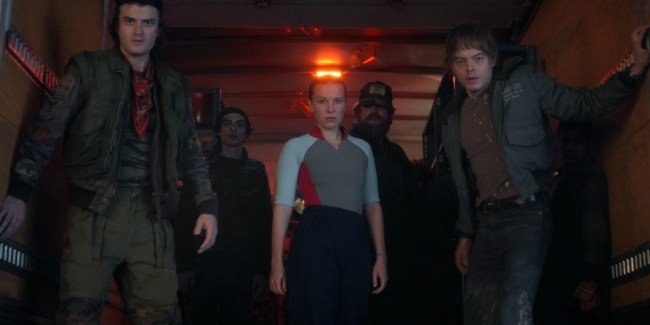
A funny thing happened when Netflix put the “Stranger Things” finale in theaters: Fans got tickets. A lot of tickets.
The AMC Kips Bay in New York City listed 11 screenings as “almost full” on New Year’s Eve alone. (There are New Year’s Day showings, as well.) The 34th Street theater filled up nine screenings, and Lincoln Square had five showings nearing capacity. The same demand was seen on the opposite coast in Los Angeles, where The Grove packed the house for seven screenings, the Century City AMC had eight, and Universal CityWalk turned out 11. Chicago, Dallas, Philadelphia, and more cities where the finale is playing saw similar demand, and all of these sales took place days before showtime. (These figures were tallied on Sunday, December 28.) By New Year’s Eve, Netflix’s latest “event” screenings should be even busier.


Now, this may not be surprising to some of you — “Stranger Things” is one of the most-watched properties on Netflix, and tickets were available for free, so long as you pre-paid for concessions (at AMC, the minimum was $20 per person) — but the box office rush took me off guard. So much of the discussion (online and off) around the last few seasons has skewed negative — egregious episode lengths, repetitive storytelling, lackluster thrills — I forgot that the silent majority either still likes what they’re seeing or likes it enough to keep tuning in.
Even so, it’s one thing to get people to watch at home for the cost of a monthly subscription, and — as many a studio executive will tell you — it’s quite another to get people to go out to a theater and buy a ticket. That thousands of people will ring in the new year by watching TV at their local cineplex — despite its simultaneous availability at home, on the same platform where fans have watched every other episode — tells us just how popular the series remains. (And just how popular communal viewing experiences remain.)
I doubt Netflix will announce exactly how well (or how poorly) “Stranger Things” does in its limited theatrical run, but even the anecdotal evidence supports an unconventional path forward for the series. Maybe what’s next for the Hawkins gang isn’t another series at all. Maybe they should stay in theaters long-term.
OK, before unpacking that plan, I hear you: The finale hasn’t even been released yet, so why are we jumping ahead to what’s next? Well, because we know “Stranger Things” isn’t really going to end with Season 5, Episode 8, “The Rightside Up.” Short-term, there’s an animated spinoff, “Stranger Things: Tales from ’85,” set to premiere in 2026. Long-term, “Stranger Things” is one of the few properties Netflix can even claim as a legitimate franchise. (Remember when “The Witcher” was a franchise? No? That’s because it didn’t last long.) Even if the Warner Bros. acquisition goes through, granting Netflix access to the studio’s treasure trove of proven I.P., the surviving executives aren’t simply going to forget about their old toys because they can now play with Batman and Superman.
And believe me: I’d love it if they did forget. “Stranger Things” was originally conceived as a limited series, and each new season only underscored why its narrative wasn’t meant for unlimited growth (personified quite well by the main cast’s awkward, timeline-shattering growth spurts). A definitive ending would be great! But in a TV era that’s revived everything from “Sex and the City” to “The Sopranos” (not to mention raising “Dexter” from the dead), it’s absurd to expect more recent hits to wrap things up for good.
Really, the expansion has already begun. Netflix has been churning out supplemental products in ancillary markets for years, and all of them — the books, games, even the Broadway show — feel like the secondary stories they are. Will the animated spinoff be any better? It’s too soon to say, but given it takes place “between Seasons 2 and 3,” I’m not holding my breath.
So while contemplating what that franchise could look like — aka while staring down the barrel of watching (and reviewing) umpteen “Stranger Things” spinoffs, prequels, and side quests — I came to the (professionally convenient) conclusion that the series needs a reinvention. It shouldn’t jump back to show us the origins of Hawkins Laboratory or “fill in the gaps” between preexisting seasons. It shouldn’t reboot itself in a new town or a new time period. It shouldn’t launch a spinoff centered on Holly Wheeler or “Delightful” Derek.
In other words, “Stranger Things” shouldn’t become a universe. It should just make sequels. And those sequels should be movies.

Why? Well, to start with, creators Matt and Ross Duffer have always been preoccupied with movies. Their series is fueled by nostalgia, and that nostalgia largely stems from classic films like “E.T.,” “The Goonies,” and “Alien” (among many, many other influences). Their narrative structure can also skew closer to a long movie than a proper TV show, since seasons tend to distinguish themselves more clearly than episodes do. When trying to pinpoint a notable hourlong arc — not a moment or set piece, but an identifiable story contained within a single episode — my mind first went to the show’s biggest flop (Season 2’s “The Lost Sister,” in which the Duffer brothers tried their hands at a backdoor pilot).
That catastrophe very much included, it often feels like the Duffers look down on television. They’ve repeatedly referred to their TV show as a movie, and they eschew TV terminology in describing “Stranger Things” whenever possible: Episodes are called “chapters,” and seasons are labeled like movie sequels. To watch, say, “The West Wing” on Netflix, you’ll click a drop-down menu and choose to start with Season 1, Season 2, Season 3, etc. To watch “Stranger Things,” that same drop-down menu simply offers “Stranger Things 2,” Stranger Things 3,” “Stranger Things 4,” or “Stranger Things 5.” “Season” is nowhere to be found.
Seasons also don’t appear to be their priority going forward. When the brothers moved their overall deal from Netflix to Paramount, they mentioned their “ambition to write, produce, and direct large-scale theatrical films.” Sure, the deal includes TV and streaming projects, too, but including this particular language in the official announcement sure sounds like they’ll be concentrating on the big screen for a bit.
So why not let them? Sure, what the Duffer brothers want may be beside the point — I won’t pretend to know how to sort out the legal complications between their new deal with Paramount, Netflix’s rights to “Stranger Things,” and its pending acquisition of Warner Bros. — but if we assume the creators will somehow be involved in the franchise moving forward, the case for moving forward with movies makes even more sense. Finales kill momentum. Sequels need to bring it back. Not only might movies spark the brothers’ creative interest (in a way the last few seasons clearly haven’t), but they could also reignite cultural interest.
Call it wishful thinking, but aren’t we tired of Hollywood’s modern franchise playbook? Everything is connected, every setting is a universe, and every story is worth telling somehow. Maybe it’s a limited series that gets turned into an ongoing series, so long as the first season hits. Maybe it’s a reboot that brings in a new cast, only to bring back the old cast when audiences are bored with the new one. Maybe it’s a spinoff of a spinoff, made mainly to sell soundtracks.
For as complicated as these franchise tie-ins can sound, they’re easy to see through. People are exhausted with prequels; for every “Andor” there’s an “Obi-Wan Kenobi” and a “Book of Boba Fett,” for every “House of the Dragon” there’s a “Rings of Power” and “Dune: Prophecy.” Spinoffs aren’t as out of favor at the moment, but their long TV history has taught us just how tricky they are to pull off; usually, the best ones require a revamp, like “Frasier” (after “Cheers”) or “The Good Fight” (after “The Good Wife”), or they’re so formulaic, they just need to keep the train on the tracks (like your “NCIS” and “Chicago” shows).
“Stranger Things” isn’t really conducive to either tack. As much as Netflix would love to launch “Stranger Things: Normal, IL,” the series isn’t rooted in a case-of-the-week structure — spinoffs will need their own narrative engines. And as much as Netflix loves spinoffs (“Wednesday,” “The Gentlemen,” “Queer Eye,” every new season of “Monster” — all of which are treated like new shows: accessible to anyone and everyone, with the added benefit of serving as a gateway drug to a preexisting properties), it’s moving away from the risks typically required to make good ones. (We’re still in the “gourmet cheeseburgers” era.)
So rather than try to turn “Stranger Things” into something it isn’t, or play by modern TV’s rulebook for expanding a franchise, why not retreat to the relative safety of an old Hollywood strategy? Just make sequels. Bring back as many of the main cast members as you need. (I’m sure many of them will be available for the right price.) Continue the existing story. (If Vecna can just “return” as the Big Bad after Season 4, he can either come back again or, preferably, the Duffers can cook up another creepy villain.) Release a new entry every five years or so (to protect the brand and build anticipation the old-fashioned way — waiting). Plus, TV doesn’t need more blockbusters, while movies (and theaters) still do.
Ending the series gives the franchise a key opportunity to course-correct. The repetitive plots can be jettisoned. (Dream big for the big screen, Duffer bros.) The exorbitant cast can be culled. (No more new characters to fill out side quests that only exist to pad out an eight-hour season.) The movies can be movie-length without people complaining about two-hour “episodes,” and the narrative timeline can be adjusted to accommodate whoever comes back. (No more 25-year-olds playing teens! Hooray!) Making sequels into movies also fits Netflix’s presumed future (with Warner Bros.), and it fits the show’s original inspirations. (Here’s hoping the sequels’ quality skews closer to “Aliens” than “Poltergeist II: The Other Side.”)
But most of all, movies feel like what “Stranger Things” has always wanted to be. The Duffers were inspired by the films of their youth, so let them work out what’s next in the same form. After all, TV doesn’t need more blockbusters, but movies — and theaters — still do.
(Correction: A previous version of this story stated fans bought tickets for the “Stranger Things” finale, when they only paid the requisite concessions fees.)
“Stranger Things” Season 5, Volume 3 — the series finale — premieres Wednesday, December 31 at 8 p.m. ET on Netflix and in theaters.