We Pick the 17 Best Films
When the 2026 Sundance Film Festival wrapped this weekend, it marked the end of a remarkable run for America’s most essential film festival. And while Sundance is very much not over, when it bows in 2027 in Boulder, Colorado, it will look very different. 2026 spelled the last time for many decade-long traditions — splashy premieres at the Eccles, packed parties in strange little retail locations, slushing up and down Main Street, the salad bar at Grub Steak — and so, of course, it all came with a hearty dose of nostalgia.
And movies! Over the course of dozens of reviews and interviews from our faithful staff and merry band of freelancers, IndieWire dug characteristically deep into the 2026 lineup. As ever, we came away with a number of films we can easily term the best of the fest. They are as follows.


If you’d like to see what the Sundance juries and audiences thought were the best films, you can check out the full list of award winners right here (there is a fair amount of crossover to be found). And, if you’re eager to learn more about how, where, and when you can see these films, check out our ever-evolving list of sales, both before, during, and after the festival.
All films are listed in alphabetical order. David Ehrlich, Ryan Lattanzio, Chris O’Falt, Anne Thompson, and Christian Zilko also contributed to this list.
“Buddy”
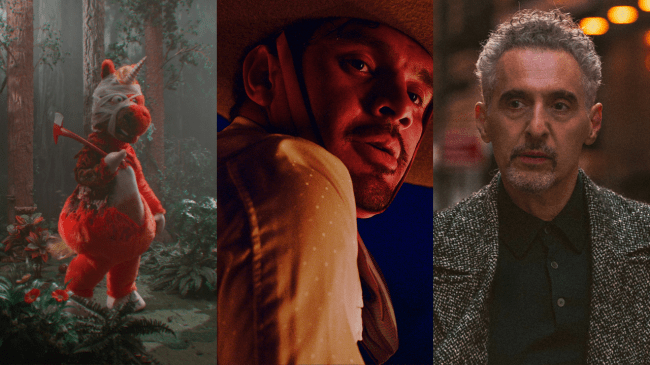
Projects like “Too Many Cooks” have proved that Adult Swim legend Casper Kelly can cram far more creativity into a short film than you’ll find in most features. So it should come as no surprise that when he finally got a chance to make a proper feature — one that, with all due respect to the “Adult Swim Yule Log” series, didn’t have to be disguised as a glorified screensaver — he delivered a must-see cinematic event.
“Buddy” is an easy elevator pitch (it’s “Barney” as a horror movie), but the high concept wouldn’t have played nearly as well in anyone else’s hands. Kelly’s reverence for the analog quirks of old TV shows is on full display, and he backs it up with some serious horror chops to deliver a hilariously bloodthirsty good time. It’s the first great midnight movie of 2026, and should be on everyone’s radar screen if and when it gets the theatrical release that it so clearly deserves. —CZ

“Carousel”
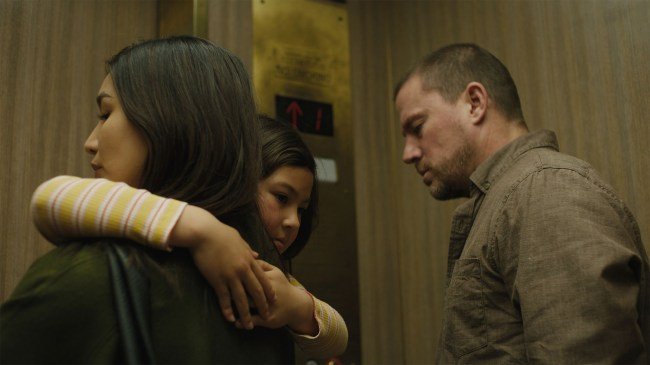
The star of “Carousel” isn’t Chris Pine, or Jenny Slate, or even any particular setting or plot device. It’s the pacing. Rachel Lambert’s latest feature doesn’t tell a remarkable story to an outside observer: it’s about a single dad struggling to keep his small family medical practice alive while dipping his toe into a romance with his daughter’s debate coach, who is pondering a return to Washington D.C. to resume her own career. But it’s a film that’s better watched than described, as Lambert’s skillful eye rotates between key live events so smoothly that you get the experience of aging alongside Pine and Slate. It’s a delicate, tender, and unapologetically adult story, giving “Carousel” a timeless quality that is likely to age very well. —CZ
“Closure”
Ten years was entirely too long of wait for Polish director Michał Marczak’s followup to “All These Sleepless Nights,” but it was worth it, as his latest is confirmation he is one of the most exciting and gifted filmmakers working today. The film follows a desperate father, Daniel, in his search down the vast Vistula River for the body of his missing teenage son, Krzysztof, who they’ve been given reason to believe committed suicide by jumping off a bridge into the water.
The film is poignant, emotional, empathetic, and speaks to the larger issues facing a generation of on-line teenagers for whom the suicide rate has dramatically jumped in recent years. “Closure” is also deeply cinematic, and like “All These Sleepless Nights” might (as it did for some at Sundance) confuse audiences as being a scripted narrative film. —CO

“Filipiñana”
It’s hard to say how many golf courses there were in the Philippines when America relinquished control over it in 1946, but today there are between 30 and 40 in the vicinity of Manila alone. One of them was built over a former sugar plantation where 14 striking workers were massacred in 2004. Director Rafael Manuel is vague about the history of the fictional country club where his languidly unnerving “Filipiñana” takes place, but the director shoots the place with a Haneke-like remove that makes every member, caddie, and Chinese tourist feel like they’re conspiring to bury an awful secret of some kind.
The sly and needling “Filipiñana” invites us to see the country club from several different points of view, if only so that we can feel them all sludging together under the brutal Manilan heat. The closest thing we have to a protagonist is a poor girl from Ilokos who’s tasked with returning a misplaced golf club to the club’s president, which spurs her closer into the belly of the beast, and closer to the source of her nagging unrest. Wry and damning in equal measure, Manuel’s feature debut builds to a final scene that acutely subverts the grammar of Western cinema to literalize its heroine’s relationship to her own erasure. —DE
“The Friend’s House Is Here”
In dialogue with Abbas Kiarostami as much as Jacques Rivette, Hossein Keshavarz and Maryam Ataei’s made-in-sect Iranian film “The Friend’s House Is Here” follows two artists and best friends against the backdrop of social upheaval in Tehran. As both are weighing whether or not to emigrate, they mix and mingle with a community of artists who give this film real, lived-in scope. There’s a deadpan humor to this clandestine production that gives way to sadness — but not the level of suffering you might expect from such a story, even as the women inevitably must separate. This is a delicate, unexpectedly powerful slice of cinema literally unveiled, the filmmakers as liberated as the characters hope to one day be. —RL

“Gail Daughtry and the Celebrity Sex Pass”
Director David Wain’s return to Sundance delivered exactly what most of us were hoping for: A hysterical film that belongs alongside Wain’s “Wet Hot American Summer” and “They Came Together,” two of the funniest American films of this century. Zoey Deutch stars as the wide-eyed Gail, who journeys to Los Angeles to find and bang her celebrity hall pass crush, Jon Hamm, after her fiancée (Michael Cassidy), in unexpected fashion (to say more would spoil the film’s first hysterical set piece), has taken advantage of his. Gail’s search for Hamm forms an unlikely posse that starts with fellow hair dresser and bestie (Miles Gutierrez-Riley), and picks up along the way a recently fired CAA mail room clerk (Ben Wang), crest-fallen paparazzi photographer (Ken Mario, who co-wrote the film with Wain), and John Slattery playing a satirical version of himself as the down trodden actor who can’t get his “Mad Men” co-star to return one of his texts.
One of the joys of the film is the way Wain and Marino put to full use their wide ensemble of comedians, including their long-time collaborators and some new ones, to create a zany slapstick ride as a hairdresser’s convention, the mob, and the Hollywood movie business collide. —CO
“The History of Concrete”
When most people think about concrete, they think about the obvious stuff: The color gray. New York City. Why it’s generally a bad idea to jump off tall buildings. When John Wilson thinks about concrete, the erstwhile star of HBO’s “How to With John Wilson” thinks about DMX, Hallmark movies, Kim Kardashian, public diarrhea, a trailblazing Asian American judge, the world’s first 3D-printed Starbucks, and a 3,100-mile footrace that honors a dead Brooklyn cult leader. What do those things have in common? Possibly everything! Maybe a little bit less than that. But definitely, definitely at least this: They’re all things that John Wilson thinks about when he thinks about concrete. And that turns out to be all the connective tissue we need to appreciate the relationship his consistently hilarious and sneakily profound debut feature maps between them.
It would be a waste of time to walk you through how Wilson gets from 49-cent royalty checks and rueing his life as a Ridgewood landlord to the oldest buildings in Rome and a brick-laying contest in Las Vegas, but suffice it to say that concrete serves as the great connector. As Wilson mourns the death of his HBO show and searches for new purpose, concrete becomes a convenient metaphor for the impermanence of all things. “The History of Concrete” is nothing if not a sprawlingly beautiful self-portrait of a man trying to strike a balance between letting go and holding on. A man trying to make space for grief at the same time as he scrambles for self-preservation. —DE

“The Invite”
If the chatter is to be believed, the big-time bidding war that took hold after the film’s splashy premiere at least partially hinged on getting Olivia Wilde’s third directorial feature a theatrical release. True or not, selling this one to A24 guarantees precisely that and some sort of wildly fun and creative marketing campaign to boot.
The film is deserving of that attention, and more. A crackling, crazy, wildly entertaining flick, Wilde not only hits a high-mark in her directing, but her performance as well. Neatly built around four very different performances — though every star, including Wilde, Seth Rogen, Edward Norton, and Penelope Cruz, appears to be having the time of their lives — Wilde gets excellent stuff from everyone, especially herself, in a delightfully daffy and unexpectedly muscular performance as an unhappily married woman with major anxiety. The only thing that could make all that worse? Throw a dinner party on top of it! Most viewers can probably see what’s coming once this foursome (Wilde and Rogen the uptight couple who invite their very cool upstairs neighbors, played by Norton and Cruz) is smashed together with little food, lots of booze, and plenty to say, but the pleasures of watching it all unfold outmatch any of that. And with a crowd? The party of the year! —KE
“Jaripeo”
Filmmakers Efraín Mojica and Rebecca Zweig reframe the Mexican archetype of masculinity with their beautifully lensed, hybrid documentary out of the NEXT section, “Jaripeo.” The film takes us to the Mexican state of Michoacán, to the rodeos, or jaripeos, where masculinity is revealed as the performance, and the jaripeo as the true expression of one’s queer identity. Two locals, Noé and Joseph, bring the filmmakers intimately inside their world while being themselves on opposite ends of the macho spectrum; one is a cowboy and the other a make-up artist. The movie mixes vérité Super 8 with artfully constructed interstices that locate poetry in growing up queer and in the shadows. A long conversation between the pair about queerness and desire suggests that the filmmakers would have a future in narrative filmmaking, too. —RL
“Josephine”
At this point, we probably don’t need to expound further on the greatness of Beth de Araújo’s sophomore outing, but you know what? We’re going to. The winner of both the Grand Jury Prize and the Audience Award, de Araújo’s film was already the best film at the festival long before it was crowned officially as such at last Friday’s awards ceremony.
Having seen the film before I hit Park City, I was able to talk it up to just about anyone willing to listen. One thing I noticed? Many people a) didn’t realize she’s the filmmaker behind the staggering “Soft & Quiet” or b) hadn’t even heard of that film. To those people: read IndieWire, folks. De Araújo has been one to watch, a filmmaker of great clarity and vision, one who is not only willing to take on horrifying stories, but to bring them actual new dimension without exploitation. Her second film is just more of the same, and we can only hope it is the continuation of an already stellar career. —KE

“Knife: The Attempted Murder of Salman Rushdie”
As the author Salman Rushdie remembers it, the first clear thought that came to him after the brutal 2022 knife attack that almost took his life was simple: “We need to document this.” Fortunately, Rushdie’s beloved wife, fellow writer and multidisciplinary artist Rachel Eliza Griffiths, was on hand with a fierce dedication and a new camera. (Griffiths remembers her take on the idea to document the after-effects of the attack with a little more bite: “We said that we want everyone to see.”)
And see we do in Alex Gibney’s “Knife: The Attempted Murder of Salman Rushdie,” which combines Griffiths’ footage (she is credited as one of the film‘s cinematographers; she is also its true heart) with archival material, new animations, tons of movie clips, and Rushdie’s own work (mostly from his 2024 memoir “Knife: Mediations After an Attempted Murder,” but with plenty from his seminal “The Satanic Verses”). Gibney’s film doesn’t ease into it at all, opening with a clip of the attack, squarely dropping us into the horror of it. Rushdie provides voiceover throughout, and there is an immediate impact from hearing a man narrate his own attempted murder, and with such a calm (and often darkly humorous) demeanor. It’s a tough sit, but extremely worth the effort. —KE
“Leviticus”
Australian writer/director Adrian Chiarella makes a major debut with the queer horror movie “Leviticus.” It stars Joe Bird, Stacy Clausen, and oh-how-we-missed-her Mia Wasikowska in a story about closeted teens who are haunted by the thing they desire the most: each other. Naim (Bird) and Ryan (Clausen) steal away for a furtive romance that becomes the only thing worth living for in their small town, but it’s also presided over by a conversion therapy cult into which Wasikowska, who plays Naim’s mother, has brought her son. The “It Follows” comparisons are apt as the boys are stalked by phantom versions of one another who feed into their secret desires, but Chiarella’s vision is wholly original. The emotions it delivers on — especially ending with Frank Ocean’s track “Self Control” — become almost overwhelming for anyone who’s gone through the queer experience. This is a sad, scary debut from a filmmaker we can’t wait to see more from. —RL
“The Only Living Pickpocket in New York”
Filmmaker Noah Segan celebrates the clash of analogue and tech in this ’70s throwback shot on the streets and subways of New York. Accompanied by a jazzy score, the movie is carried by veteran John Turturro, a veteran hustler who must use his wiles to get out of a tricky wicket when he lifts the wrong thing from the wrong person at the wrong time. With the right distributor, Turturro could land a long-overdue Best Actor nomination. —AT

“The Moment”
The closed-ended nature of a phrase like “brat summer” presented the real Charli XCX with an unenviable predicament. The pop star’s latest album gave her the biggest financial success of her career, with enough hits to fill nostalgia setlists for the rest of her life. But it was also branded as a fleeting era from the very beginning, forcing the artist to choose between dragging something out beyond its expiration date and leaving additional financial success on the table.
But it turns out there’s a third option: make a fictional documentary about yourself that sees you trying to extend an era in all of the worst ways. The unpredictable pop star chose that path, and we’re all better for it. Aidan Zamiri’s “The Moment” is a riff on “Succession” for the modern music industry (complete with an even funnier Alexander Skarsgård performance), filled with genuinely hilarious jokes about how the brand-obsessed, focus-grouped record label apparatus can kill an artist’s creativity. But more than that, it deserves to be remembered as a legendary piece of self-parody by an artist whose resume just gets more impressive by the day. —CZ
“Once Upon a Time in Harlem”
When “Symbiopsychotaxiplasm: Take One” director William Greaves died in 2014 we lost on of the greatest nonfiction filmmakers ever, with a body of innovative work that was so ahead of its time, it’s still ahead of us now. The announcement of this year’s Sundance lineup included an unexpected surprise for documentary lovers: Greaves had left behind an unfinished film he shot in 1972, when he orchestrated a reunion of Harlem Renaissance luminaries at the home of Duke Ellington. That Greaves’ son David, who served as a cameraman at Ellington’s house, was able to lead an edit of the material (a challenge that apparently alluded his father) into what will certainly be considered on of the best films (nonfiction or otherwise) of 2026 is not only the biggest surprise of this year’s Sundance, but a revelation.
“Once Upon A Time In Harlem” isn’t purely reverence, which is Greaves clearly had for his subjects. As the alcohol starts flowing, the four-hour gathering reveals not everyone has the same view of what and who made the Harlem Renaissance so important, as the living participants debate the legacy of one of the most vital cultural movements in U.S. history. —CO

“One in a Million”
One night in 2015, filmmakers Itab Azzam and Jack MacInnes met a young girl selling cigarettes on a street corner in Turkey. Her name was Israa, she was 11 years old, and like so many of the other refugees in the neighborhood her family had recently fled to the port city of Izmir in order to escape the devastation of the Syrian civil war. Smart, smiley, and bursting with undimmed enthusiasm despite such difficult circumstances, Israa was such an irresistible documentary subject that Azzam and MacInnes — who had fled Syria themselves in 2011 — decided to follow the girl’s family as they continued along their perilous trek to Germany.
Upon reaching Cologne, however, it quickly became apparent to the directors that the most fraught and complicated portion of Israa’s exodus was just beginning. The journey from Aleppo had almost been as dangerous as it would have been for her family to stay there, but neither artillery shells, overcrowded boats, nor the constant threat of being sent back were as difficult for the girl to survive as the twin pains of exile and assimilation. Azzam and MacInnes would continue to film Israa for another 10 years, only stopping — as we see in the recently shot bookends of the sweeping, humane, and deeply heartsick documentary they’ve cut together from that decade of footage — when she was able to safely visit Syria again in 2025. “War is not the hardest thing a person can go through,” Israa’s voiceover intones as she looks at the bombed out ruins of the neighborhood where she was raised. “It’s not as hard as what comes after.” By the end of “One in a Million,” you understand exactly what she means. —DE
“Time and Water”
A filmmaker who knows how to connect emotional stories to the forces ravaging our planet, Sara Dosa has done it again. After “Fire of Love,” about a love triangle between a French scientist couple and volcanoes, wowed Sundance 2022 and was scooped up by NatGeo, which took it to an Oscar nomination, Dosa returned to another science love story that had been back-burnered during the pandemic. She had consulted with writer/poet/eco-activist Andri Snær Magnason on the Icelandic film “The Seer and the Unseen” (2019).
For her latest eco-doc “Time and Water,” she reconnected with him to tell two stories: his family’s obsession with glaciers, using his video archives, and the death of Iceland’s first glacier. This won’t be the last, as we see gorgeous footage of glaciers, still alive, but melting. —AT